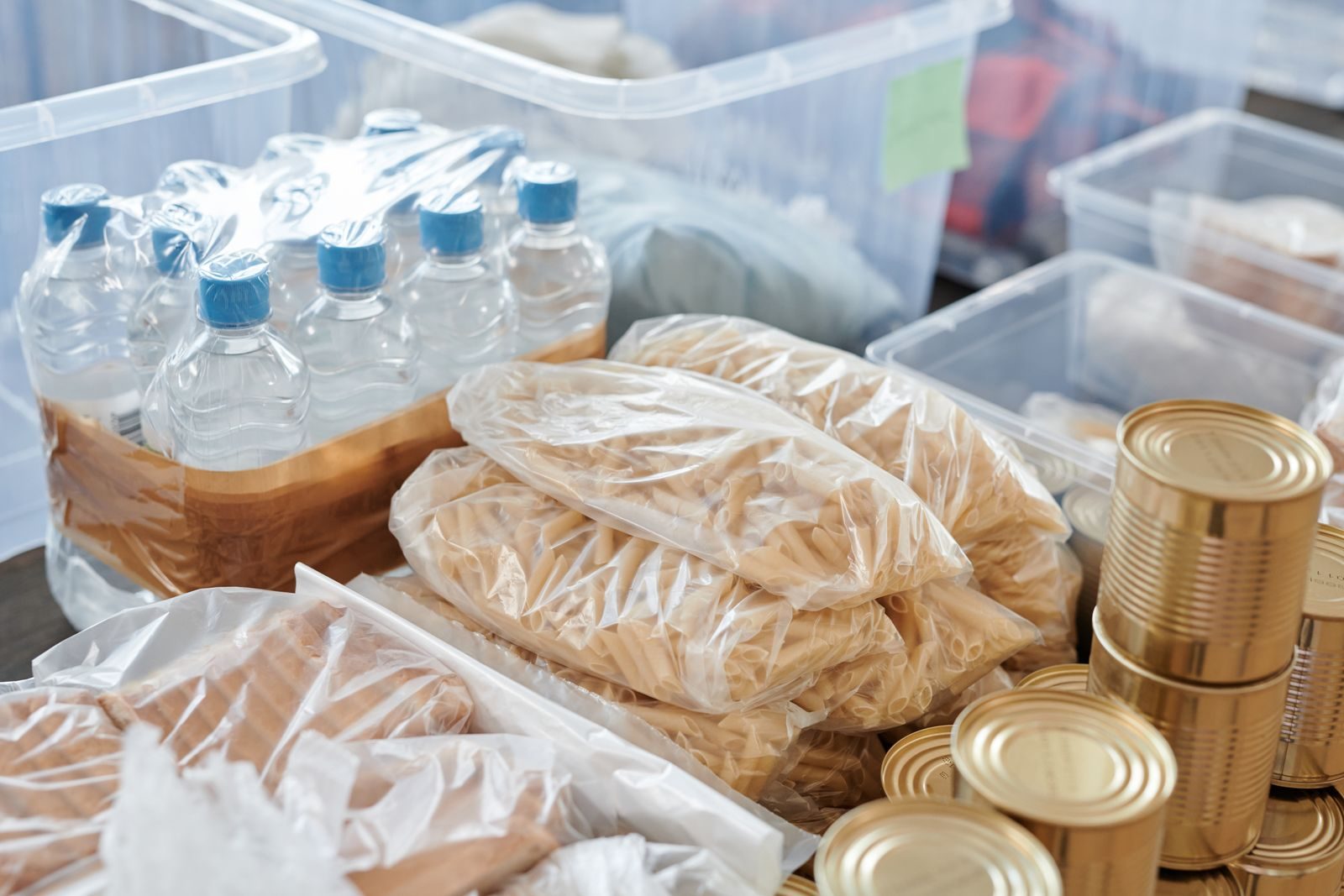
Most of an outage kit comes from the supermarket and the pharmacy. The amounts below are per person per day unless a line says otherwise. Count a child (2 to 12) as about three quarters of an adult for food, and round every total up to a whole pack. The store list does the sums for your household.
Water and drinks
- Small bottled water (500 mL / 16.9 oz): 12 per person in total, counted toward your water target
- Large jugs: only to fill the gap to 1 gal (US) or 4 L (Canada) per person per day
- Juice boxes: 1 per child per day
- Instant coffee, tea and cocoa for each drinker
Canned goods
- Ready-to-eat canned meals (chili, stew, ravioli, hearty soup): 1 per day
- Small cans of protein (tuna, chicken, salmon, beans; 3 to 5 oz / 85 to 142 g): 1 per day
- Fruit cups or apple sauce pouches: 1 to 2 per day
- Canned vegetables or vegetable juice: 1 every 2 days
Pantry, snacks and bakery
- Crackers or rice cakes, salt-free if water is tight: 1 box per week
- Cereal or granola: 1 box per week
- Peanut or seed butter: 1 jar (16 to 18 oz / 500 g) per week
- Trail mix, nuts, dried fruit or jerky: 1 bag per week
- Granola or protein bars: 2 per day
- Comfort food: a few treats each
- Bread, bagels or tortillas: 1 pack per household for the first 3 to 4 days
Dairy shelf, freezer and ice
- Shelf-stable milk, single-serve boxes: 1 per adult and 2 per child per day
- Shelf-stable whole milk for toddlers (12 to 24 months): 16 oz (473 mL) per day
- Water jugs and gel packs frozen to fill every gap in the freezer
- Ice on the day: 1 bag per cooler per day; block ice lasts longer than cubes
Baby and pet
- Diapers: 8 per baby per day, 12 for a newborn
- Baby wipes: 30 per baby per day, at least 2 packs
- Ready-to-feed formula: 32 oz (946 mL) per formula-fed baby per day
- Baby food pouches or jars (6 to 24 months): 3 per baby per day
- Pet food: the daily amount on the bag × your days, rounded up to the next full bag
- Cat litter: about 1 lb (0.45 kg) of clumping clay per cat per day
- Poop bags: 1 roll per dog per week
Paper, cleaning and hardware
- Toilet paper: 1 roll per person every 3 days, at least 4 rolls
- Paper plates, bowls, cups and cutlery: 3 of each per day, to save washing water
- Heavy-duty garbage bags: 1 per day for the household
- Plain unscented bleach (6% or 8.25%): 1 bottle per household, under a year old, and a dropper labelled “bleach only”
- Hand sanitizer with at least 60% alcohol: 1 bottle (about 250 mL / 8 oz) per 2 people per week
- Dish soap, disinfecting wipes, coffee filters and gallon zip bags: 1 of each per household
- Batteries in the sizes your lights and radio take
- Propane, 1 lb cylinders (houses with a camp stove): 2 for 3 days, 4 for 7, 7 for 14
Pharmacy and checkout
- Prescription medicines: 7 days minimum, 14 if possible; ask about an early refill
- Pet medication: 14 days
- Pain and fever relief, with children’s or infant versions if you have kids
- Anti-diarrhea medicine, antacids and laxatives: 1 of each per household
- First aid refills: a box each of bandages, antiseptic wipes and gloves
- Spare glasses, contact lens solution, hearing aid batteries, menstrual supplies
- Cash in small bills and coins: card readers and ATMs need power
What people forget
- A manual can opener, even with pull-tab cans
- Single-serve sizes, because opened canned meat, fish and milk can’t be kept once warm
- Ice for the cooler, frozen ahead in water jugs
- Unscented bleach: scented and colour-safe types aren’t safe for treating water
- Next-size-up diapers if the baby is close to a change
- Comfort food and instant coffee: small routines help
Rotate it into normal meals
Buy food you already eat, so the kit can feed into your weekly meals. Put new cans at the back and eat the older ones first (FEMA). Public Safety Canada says to replace kit food at least once a year, and Health Canada says every year or by the label date.
Some things turn over faster. FEMA’s booklet suggests using crackers, dried fruit and boxed powdered milk within six months, and canned soups, fruit, vegetables, cereal and peanut butter within a year. NDSU Extension gives low-acid canned meat and vegetables two to five years, so cans are the forgiving part. Throw out any can that is swollen, dented or corroded (Ready.gov).
An easy rhythm: every six months, when you replace the water you bottled yourself (CDC), eat down the crackers, bars and dried fruit and restock. Once a year, do the same with the cans. For the things a supermarket doesn’t sell, the kit builder covers the rest.
Sources (16)
- Ready.gov, Food
- Ready.gov, Build a Kit
- FEMA and American Red Cross, Food and Water in an Emergency
- CDC, Keep Food Safe After a Disaster or Emergency
- CDC, How to Create an Emergency Water Supply
- CDC, Emergency List for Families With Infants and Young Children
- Virginia Department of Health, Refrigerated Food and Power Outages (FoodSafety.gov chart)
- NDSU Extension, FN1468 food storage
- AAP HealthyChildren.org, Recommended Drinks for Young Children
- Pampers, How many diapers a day
- AVMA, Pet evacuation kit checklist
- American Red Cross, Survival Kit Supplies
- Public Safety Canada, Emergency kits
- Health Canada, Food and drinking water safety in an emergency
- Canadian Red Cross, Emergency kit list
- Clorox, How to tell when a bleach bottle was made
Turn the advice into a shopping list
Tell us who lives at home and how many days you want to cover. We work out the amounts, you pick what to buy and what you already have.
Build a kit for your household
About 5 minutes. We work out the amounts for you.