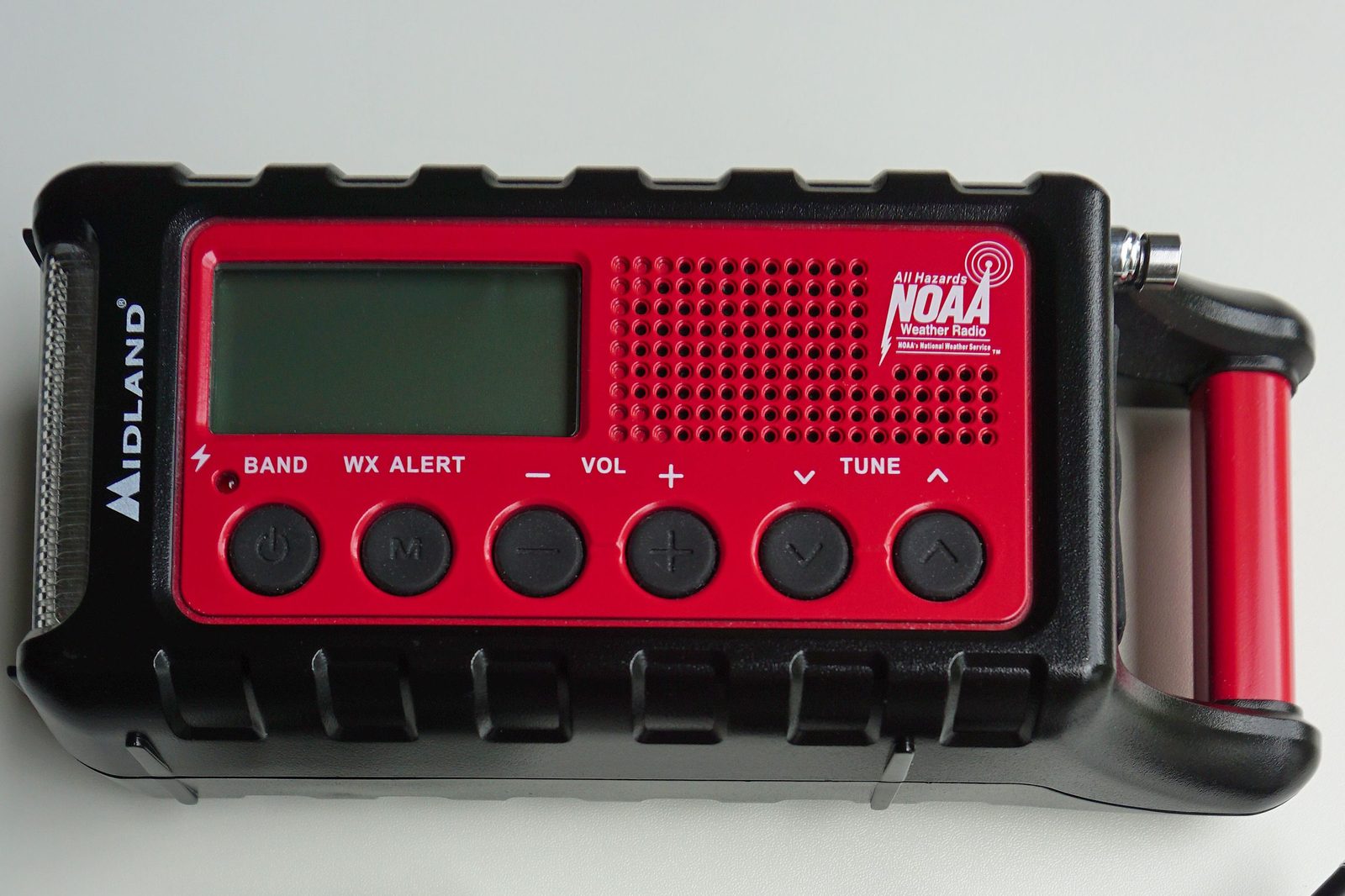
In the US, keep a NOAA Weather Radio with an alert feature, so it can sound for a warning even with the volume down, and make sure it runs on batteries or a hand crank. In Canada, Weatheradio Canada shut down in March 2026, so keep a crank or battery AM/FM radio: Alert Ready warnings come over local radio, TV and phones. Either way, pick a radio with at least two ways to power it.
Why a radio still matters
When the power goes, home internet goes with it. Public Safety Canada says to keep a crank or battery radio in your kit in case the internet is down, and Ready.gov’s kit list includes a battery or hand-crank radio and a NOAA Weather Radio with tone alert. Official warnings reach radio in both countries: US stations carry them through the Emergency Alert System (FEMA), and Canadian broadcasters have carried emergency alerts since 2014 (CRTC).
In the US: NOAA Weather Radio
NOAA Weather Radio broadcasts forecasts and warnings 24 hours a day from more than 1,000 transmitters, on seven frequencies between 162.400 and 162.550 MHz (NWS). A plain AM/FM radio can’t pick these up, so look for “weather band” or “NOAA” on the box. Many weather radios can sound an alarm, but some can’t, so check before you buy.
- Public Alert logo. Radios with this logo meet a standard that includes SAME, battery backup and a tone alarm (NWS).
- SAME. You enter your county code, found online or by calling 1-888-NWR-SAME, and the radio alarms only for warnings in your area.
- Tone alert. A tone sent before most warnings switches on an alert radio even when the volume is off, so it can wake you at night.
Ready.gov’s list names both kinds. One simple way to follow it: a plug-in alert radio with battery backup by the bed, and a crank radio in the kit.
In Canada: AM/FM, Alert Ready and WeatherCAN
Environment and Climate Change Canada switched off Weatheradio in March 2026 and now points people to the WeatherCAN app and its weather website. A NOAA radio in Canada only picks up US stations near the border, so you don’t need to pay for a weather band unless you live close to one.
- AM/FM radio. Alert Ready sends warnings through television, radio and compatible LTE phones. Public Safety Canada says to tune into a local radio station on a battery-powered or wind-up radio during an outage. Write down your local news station’s frequency and keep it with the radio.
- WeatherCAN. The free app sends push notifications for severe weather, air quality and extreme temperatures. Install it while you have power.
Batteries, crank or solar
Each power source has a job. The best emergency radios take two or three.
| Power | What the makers say | Good for |
|---|---|---|
| AA or AAA batteries | Midland’s WR120 alert radio plays NOAA broadcasts for up to 12 hours at full volume on 3 AA | Long outages, with spares from your light kit |
| Built-in rechargeable | Midland’s ER310 has a 2,600 mAh battery that charges by USB, crank or sun, and can also run on AA | Charging up before a storm |
| Hand crank | One minute of cranking gives up to 9 minutes of radio (Midland ER310) | When batteries run out |
| Solar panel | One hour in good sun gives up to 45 minutes of radio (Midland ER310) | Slow topping up on sunny days |
Solar is slow. Eton says its FRX3+ takes about 10 hours to recharge in the sun, against about 2 hours from USB. Midland suggests keeping the WR120 plugged in when you can, so its batteries are there for the outage. If your radio takes AA or AAA, keep a spare set in the box with your lights; our battery guide has the counts.
Charging a phone from a radio
Many crank radios have a USB port for a phone. Canada’s telecom department (ISED) says to check the manual before counting on it, and cranking alone is hard work: Eton says 4 minutes of cranking gives about 1 minute of talk time on most smartphones. Treat the radio as a top-up and keep power banks for the phones. Our guide to staying informed has the power bank maths.
What to look for
- US: NOAA weather band with an alert, ideally SAME and the Public Alert logo.
- Canada: clear AM and FM. A weather band only helps near the US border.
- Two ways to power it, such as AA batteries and a crank, or a built-in battery and solar.
- Batteries you already stock. A radio that takes the same AA or AAA as your lights shares their spares.
- A built-in flashlight is handy, but keep headlamps and lanterns as your main light.
Set it up the day it arrives
Charge it, put in batteries and find the spot in the house with the strongest signal (NWS). In the US, enter your county code, then listen for the weekly test on Wednesday between 10 a.m. and noon local time (NWS). In Canada, find your local news station and write the frequency on the radio.
The communication step of the kit builder shows radios picked for your country.
Our picks
What the kit builder suggests right now, in the order we would pick them.
- Midland WR120B Alert Radio on Amazon (opens in a new tab) NOAA weather + SAME county alerts · plug-in with AA backup $49.99
- Emgykit Hand Crank Radio on Amazon (opens in a new tab) AM/FM/NOAA · crank + solar · 2,000 mAh · USB phone charging $32.99
- RunningSnail Hand Crank Radio on Amazon (opens in a new tab) AM/FM/NOAA · crank + solar · flashlight · USB phone charging $43.99
- Sangean DT-400W Pocket Alert on Amazon (opens in a new tab) AM/FM/NOAA · weather alert · AA or rechargeable $74.38


- PRUNUS J-150 solar AM/FM radio on Amazon (opens in a new tab) AM/FM · solar or D batteries · loud speaker $61.99
- RunningSnail Hand Crank Radio on Amazon (opens in a new tab) AM/FM/weather band · crank + solar · flashlight $81.63
- Emgykit Hand Crank Radio on Amazon (opens in a new tab) AM/FM/weather band · crank + solar · USB phone charging $62.54
- Sangean DT-400W Pocket Alert on Amazon (opens in a new tab) AM/FM/weather band · weather alert · AA or rechargeable $115.54


Prices are the last we saw on Amazon and may have changed. Outage Kits earns a commission on qualifying Amazon purchases; it doesn't change what we suggest.
Sources (15)
- Ready.gov, Build a kit
- NWS, NOAA Weather Radio
- NWS, NOAA Weather Radio receivers
- NWS, NOAA Weather Radio weekly tests
- NWS Mount Holly, NOAA Weather Radio questions
- FEMA, Integrated Public Alert and Warning System
- Environment and Climate Change Canada, Weatheradio
- Environment and Climate Change Canada, WeatherCAN
- Alert Ready
- CRTC, CRTC to protect more Canadians with wireless alerts
- Public Safety Canada, Power outages: how to prepare
- Innovation, Science and Economic Development Canada, Steps you can take to stay connected
- Midland, ER310 owner’s manual
- Midland, WR120 battery-only runtime
- Eton, FRX3+ owner’s manual
Turn the advice into a shopping list
Tell us who lives at home and how many days you want to cover. We work out the amounts, you pick what to buy and what you already have.
Build a kit for your household
About 5 minutes. We work out the amounts for you.