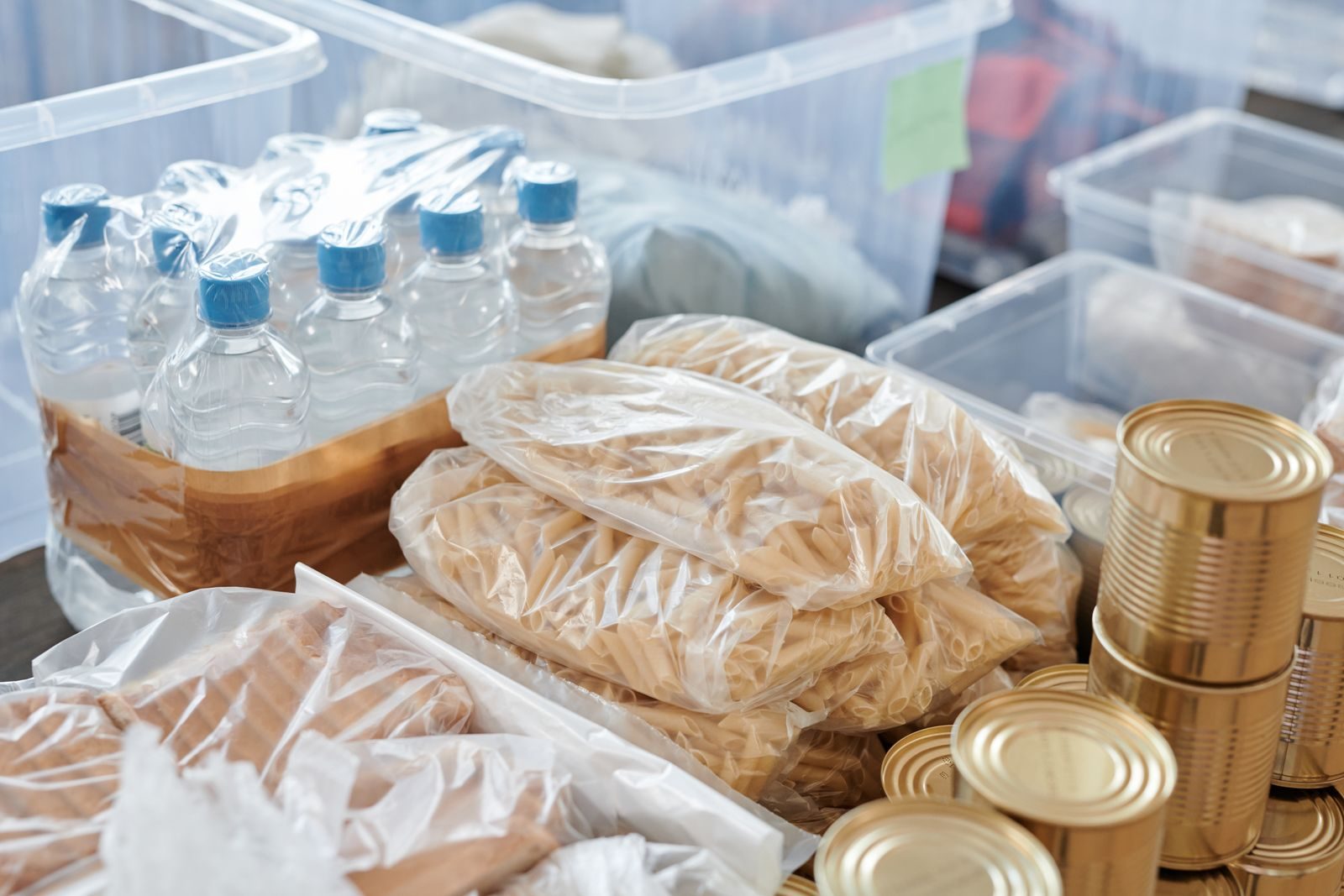
Plan on about 2,000 calories per adult and 1,500 per child each day, mostly from food that needs no cooking. Eat the fridge first, then the freezer, then the pantry. And stock what your family already eats: “Familiar foods are important. They lift morale,” as the FEMA and Red Cross food booklet puts it.
Start with food that needs no cooking
Assume no stove and no fridge. Commercially canned food is safe to eat cold, straight from the can (Ready.gov), and FEMA’s booklet says foods that need no refrigeration, water, special preparation or cooking are best. Ready.gov and the Canadian Red Cross both list the same kinds of things:
- Ready-to-eat canned meals, meat, fruit and vegetables
- Protein, granola and fruit bars
- Dry cereal or granola, with shelf-stable milk
- Peanut butter, dried fruit, trail mix and dried meat
- Apple sauce and canned juice
- Comfort food: Ready.gov lists comfort and stress foods, and familiar treats help kids settle
Two habits make this work. Buy single-meal sizes, because opened canned meat, fish and milk must be thrown out once they warm up, while opened canned fruit, peanut butter and condiments keep (FoodSafety.gov chart). And go easy on salt if water is tight. FEMA warns that salty foods make you thirsty and suggests salt-free crackers, whole grain cereals and canned foods with a lot of liquid instead.
Low-cook extras
With an outdoor stove you can add hot drinks, instant oatmeal and freeze-dried meals. Retailer listings put a two-serving pouch at 1.5 to 2 cups of boiling water, and Mountain House says cold water works “in a pinch” if you allow about twice as long. Only stock rice, pasta or dry beans if you have a stove and the spare water to cook them.
How much to plan for
The FDA uses 2,000 calories a day as its general guide. The Dietary Guidelines for Americans give a wide spread: about 1,000 to 1,800 for children aged 2 to 6, 1,600 to 2,400 for adult women and 2,200 to 3,000 for adult men, depending on activity. We plan 2,000 per adult and 1,500 per child aged 2 to 12, about three quarters of an adult. Teens count as adults, since the guidelines run up to 3,200 a day for ages 7 to 18.
For 2 adults and 2 children, that’s 2 × 2,000 + 2 × 1,500 = 7,000 calories a day:
| Days | Per adult | Per child | 2 adults + 2 children |
|---|---|---|---|
| 3 | 6,000 | 4,500 | 21,000 |
| 7 | 14,000 | 10,500 | 49,000 |
| 14 | 28,000 | 21,000 | 98,000 |
Babies aren’t in these sums: they get formula, milk and baby food, covered in our guide to babies and pets in a power outage. FEMA’s booklet notes that food, unlike water, can be rationed safely for a while, except for children and pregnant women.
Why emergency-meal servings mislead
Emergency food buckets count servings, and servings are small. Deseret News looked at a 150-serving ReadyWise bucket: 25,280 calories in total, about 168 a serving. At 2,000 a day, that’s about 12½ days of food for one adult, not 150 meals. Augason Farms, which sells these kits, says some servings run only 80 to 150 calories.
So read the total calories on the label and divide by your daily need. For the family above, the same bucket lasts 25,280 ÷ 7,000 = about 3.6 days. When the food step of the kit builder counts ready-made meals, it allows 3 labelled servings for an adult’s main meal and 2 for a child’s.
Ration bars work the same way. A 3,600-calorie Datrex pack (18 bars of 200 calories) is sold as a 72-hour supply, which works out at 1,200 calories a day. That’s fine for a grab-and-go bag, but plan real food for days at home.
Cooking outdoors safely
Camp stoves, barbecues and charcoal grills belong outside (Ready.gov, PreparedBC). The CDC says carbon monoxide from fuel-burning devices kills more than 500 Americans each year, and to never use generators, grills or other gasoline-, propane- or charcoal-burning devices inside your home. Ready.gov adds: don’t use a gas stove or oven to heat the house.
Stoves and grills stay outdoors
Carbon monoxide has no colour or smell. Use camp stoves and grills outdoors only, never in the house, garage or basement, and keep a battery-powered CO alarm working indoors (CDC).
- Warming food indoors: Ready.gov lists candle warmers, chafing dishes and fondue pots. Put the flame out before you leave the room (FEMA).
- Heating a can: never heat a sealed one. Take the label off, wash and disinfect the can (1 part bleach to 10 parts water), and open it before heating (Ready.gov).
- Fuel: a two-burner propane stove runs about 1 hour on high on one 1 lb (16.4 oz) cylinder, per Coleman’s spec. Allowing half an hour a day for meals and hot drinks, that’s 2 cylinders for 3 days, 4 for 7 days and 7 for 14 days.
- Apartments: with no outdoor space, plan on no-cook food for the whole outage.
A sample 3-day menu
This menu comes from our store list and assumes the outage starts with a stocked fridge. Fridge food only counts while it’s inside the 4-hour window or held at 40°F (4°C) in a cooler.
| Meal | Day 1 | Day 2 | Day 3 |
|---|---|---|---|
| Breakfast | Cereal with milk from the fridge | Cereal or granola with a shelf-stable milk box | Granola bar, apple sauce and a milk box |
| Lunch | Sandwiches from the fridge: cheese, lunch meat, bread | Small can of tuna or chicken, crackers, fruit cup | Peanut butter on tortillas, fruit cup, vegetable juice |
| Dinner | Freezer food cooked on an outdoor grill, or a can of chili | Can of chili, stew or hearty soup | Can of ravioli or stew, or one ready-made meal |
| Snacks | Cut fruit from the fridge, trail mix | 2 bars, peanut butter, trail mix | 2 bars, nuts, dried fruit, a little chocolate |
A no-cook day like day 2 comes to about 2,380 calories for an adult, going by typical labels: cereal with a milk box (about 390), tuna, crackers and a fruit cup (about 520), a can of chili or stew (about 450), and 2 bars, peanut butter and trail mix (about 1,020). The margin over 2,000 covers the food nobody wants on day five.
For one adult, 3 days of pantry food is roughly 3 canned meals, 3 small cans of protein, 3 to 6 fruit cups, 2 canned vegetables or juices, a box each of crackers and cereal, a small jar of peanut butter, 6 bars, a small bag of trail mix and 3 milk boxes. A child needs about three quarters of each line, plus 2 milk boxes a day. The store list scales this for your household and gives the 7 and 14 day amounts.
Sources (16)
- Ready.gov, Food
- Ready.gov, Power outages
- FEMA and American Red Cross, Food and Water in an Emergency
- Canadian Red Cross, Emergency kit list
- Virginia Department of Health, Refrigerated Food and Power Outages (FoodSafety.gov chart)
- CDC, Keep Food Safe After a Disaster or Emergency
- FDA, How to Understand and Use the Nutrition Facts Label
- Merck Manual, Estimated calories by age, sex and activity (Dietary Guidelines for Americans 2020 to 2025)
- Deseret News, Are ReadyWise emergency food kits worth it?
- Augason Farms, Survival food kits: servings vs calories
- Mountain House, FAQ
- SOS Products, Datrex 3,600 calorie food bar
- CDC, Avoiding Carbon Monoxide Poisoning
- CDC, Protect Yourself During a Power Outage
- PreparedBC, Get prepared for a power outage
- REI, Coleman Classic 2-burner propane stove
Turn the advice into a shopping list
Tell us who lives at home and how many days you want to cover. We work out the amounts, you pick what to buy and what you already have.
Build a kit for your household
About 5 minutes. We work out the amounts for you.