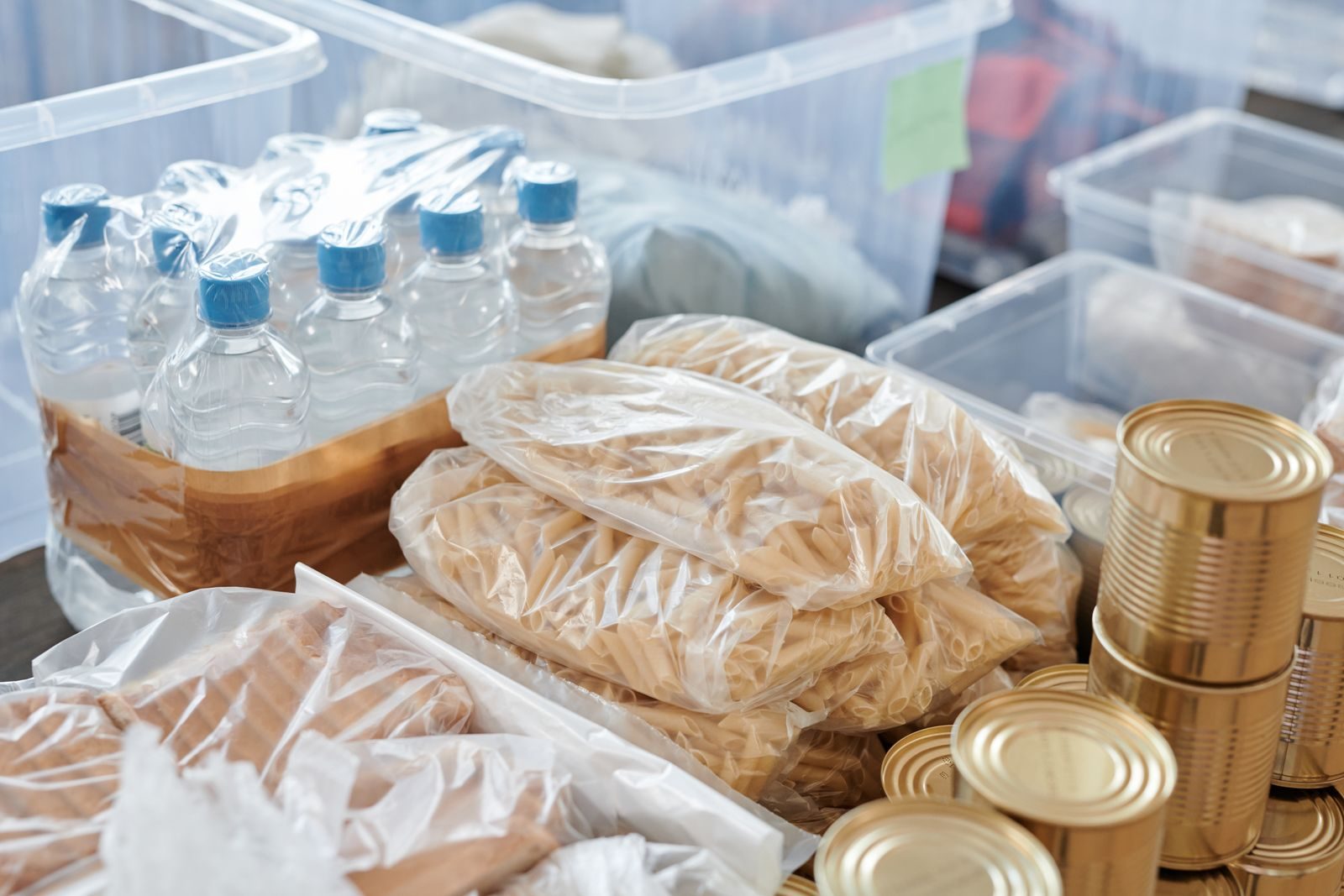
Plan on 1 gallon of water per person per day in the US, or 4 litres in Canada. That covers drinking plus a little cooking and washing. For a family of four, a week’s supply is 28 gallons or 112 L, which is four or five big jugs.
How much per person
US agencies agree on the number. Ready.gov, the CDC and the American Red Cross all say to store at least 1 gallon (3.8 L) per person per day. Ready.gov puts a normally active person’s drinking need at about three quarters of a gallon, so the rest goes on food and a basic wash.
Canadian advice varies more. Health Canada recommends 2 L to drink plus 2 L for cooking and cleaning, so 4 L per person per day, and Public Safety Canada’s kit page and PreparedBC say the same. The federal kit checklist says 2 L and the Canadian Red Cross 3 L in total. We use 4 L: it matches Health Canada’s split, and it’s close to one US gallon anyway.
Count everyone the same, babies included, since formula and bottle washing need safe water. Ready.gov notes that children, nursing mothers and sick people may need more, and that “In very hot temperatures, water needs can double.” Don’t ration drinking water unless authorities tell you to.
Pets
The only official per-pet figure is Public Safety Canada’s: 4 L a day for an average dog and 1 L for an average cat. A vet rule of thumb from PetMD is about 1 oz of water per pound of body weight a day, so a 65 lb (30 kg) dog drinks about 1.9 L. Our kit builder plans ½ gallon (2 L) per pet a day: right for most dogs and plenty for a cat. Use Canada’s 4 L for a big dog or hot weather.
Worked examples for a family of four
The sum is people × days × the daily amount. For a week in the US: 4 people × 7 days × 1 gallon = 28 gallons. In Canada: 4 people × 7 days × 4 L = 112 L.
| Days | US: 1 gal per person | Canada: 4 L per person | 7 gal (26 L) jugs |
|---|---|---|---|
| 3 | 12 gal (45 L) | 48 L | 2 |
| 7 | 28 gal (106 L) | 112 L | 4 in the US, 5 in Canada |
| 14 | 56 gal (212 L) | 224 L | 8 in the US, 9 in Canada |
A dog adds 3.5 gallons a week (½ gal × 7 days) in the US, or 14 L (2 L × 7 days) in Canada. Two weeks for four people is a lot of water: eight big jugs, or a bathtub bladder plus a few jugs. The water step of the kit builder does these sums for your household, pets included.
Containers, weights and where to keep them
- Bottled water is the easiest start. Keep it sealed in its original packaging somewhere cool and dark, and go by the date on the label (Ready.gov, CDC).
- Small bottles are worth having too: Public Safety Canada suggests some that can be carried easily. We count 12 bottles of 500 mL (16.9 oz) per person, which is 6 L toward the total.
- Refillable jugs should be food-grade, the CDC says. Otherwise pick one with a tight-closing top, unbreakable material (not glass) and a narrow opening if you can.
- Weight adds up. A litre of water weighs a kilogram, so a full 7-gallon (26 L) jug weighs about 58 lb (26 kg). Fill big jugs where they will live.
- Where: somewhere that stays at 50 to 70°F (10 to 21°C), out of sunlight and away from gasoline and pesticides (CDC).
- The freezer counts as storage. Water frozen in clean jugs keeps the freezer cold longer, then becomes drinking water as it melts. More on that in keeping food safe when the power goes out.
Rotate it
Write the fill date on every container. The CDC and Ready.gov both say to replace water you bottle yourself every six months. Public Safety Canada says to refresh the water, food, batteries and medicine in your kit at least once a year.
Before you refill, wash containers with dish soap, then sanitize them with the CDC’s mix: 1 teaspoon of unscented bleach (5 to 9%) in 1 quart (about 1 L) of water.
The water heater reserve
Your hot-water tank is a store you already have. Typical electric tank water heaters hold 25 to 55 gallons (about 95 to 210 L), according to the US Energy Information Administration. The water in your pipes and the ice in your freezer are safe sources too (FEMA, EPA). To drain the tank, FEMA’s steps are:
- Make sure the electricity or gas to the heater is off.
- Close the water intake valve at the tank.
- Open the drain at the bottom of the tank and turn on a hot-water tap.
- Refill the tank before you turn the power or gas back on.
Skip water from toilet tanks or bowls, radiators, waterbeds, pools and hot tubs (FEMA). And flush with greywater, not drinking water: US toilets can use up to 1.6 gallons (6 L) a flush, more than one person’s daily ration.
If your tap water is in doubt
Listen for a boil-water advisory on the radio. If one is in place, or you aren’t sure, treat tap water before you drink it.
Boiling is best, the CDC says. Hold a rolling boil for 1 minute, or 3 minutes above 5,000 ft (1,000 m), per the EPA.
If you can’t boil, use plain household bleach. The EPA’s doses are below. Stir, wait 30 minutes, then sniff: there should be a slight chlorine smell. If not, add the same dose again and wait 15 more minutes.
| Bleach strength | Per litre (about a quart) | Per gallon |
|---|---|---|
| 5.25 to 6% | 2 drops | 8 drops |
| 8.25% | 2 drops | 6 drops |
| Cloudy, coloured or very cold water | Double the dose | Double the dose |
Health Canada’s figure is the same: about 2 drops of 5.25% bleach per litre. Let cloudy water settle first, then pour it through a clean cloth, paper towel or coffee filter before you treat it (EPA, Ready.gov). A medicine dropper labelled “bleach only” makes the drops easy to count.
Filters and tablets help, with limits. “Most portable water filters do not remove bacteria or viruses,” the CDC warns, so choose one labelled to remove parasites and treat the filtered water as well. Purification tablets vary in strength, so follow the label (EPA).
Plain bleach only, and not for chemicals
Use plain, unscented bleach. Scented, colour-safe or added-cleaner types aren’t safe for drinking water (Ready.gov). Bleach lasts up to about a year, Clorox says, and the code on the bottle neck shows when it was made. Boiling, bleach and filters don’t remove fuel or chemicals, so if floodwater or a spill may have reached your water, drink stored water only (CDC).
Homes on a well
A well pump runs on electricity, so your taps stop when the power does. Health Canada advises against running water, showering or flushing during an outage, and says to test the water if the system loses pressure. Its advice is plain: “Have a back-up water supply ready in case of emergencies.”
On a well, store the full amount for every day you plan for, and think about planning for 14 days rather than 7. Our guide to how long to prepare for explains why.
Sources (17)
- Ready.gov, Water
- CDC, How to Create an Emergency Water Supply
- CDC, Make Water Safe During an Emergency
- EPA, Emergency Disinfection of Drinking Water
- American Red Cross, Survival Kit Supplies
- FEMA and American Red Cross, Food and Water in an Emergency
- Health Canada, Food and drinking water safety in an emergency
- Health Canada, Well water safety during and after emergencies
- Public Safety Canada, Emergency kits
- Public Safety Canada, Emergency kit checklist
- Public Safety Canada, Emergency preparedness for pets and service animals
- Canadian Red Cross, Emergency kit list
- PreparedBC, Get prepared for a power outage
- PetMD, How Much Water Should a Dog Drink?
- Clorox, How to tell when a bleach bottle was made
- US EIA, Buildings Sector Appliance and Equipment Costs and Efficiencies, Appendix B
- EPA WaterSense, Tank-type toilets fact sheet
Turn the advice into a shopping list
Tell us who lives at home and how many days you want to cover. We work out the amounts, you pick what to buy and what you already have.
Build a kit for your household
About 5 minutes. We work out the amounts for you.