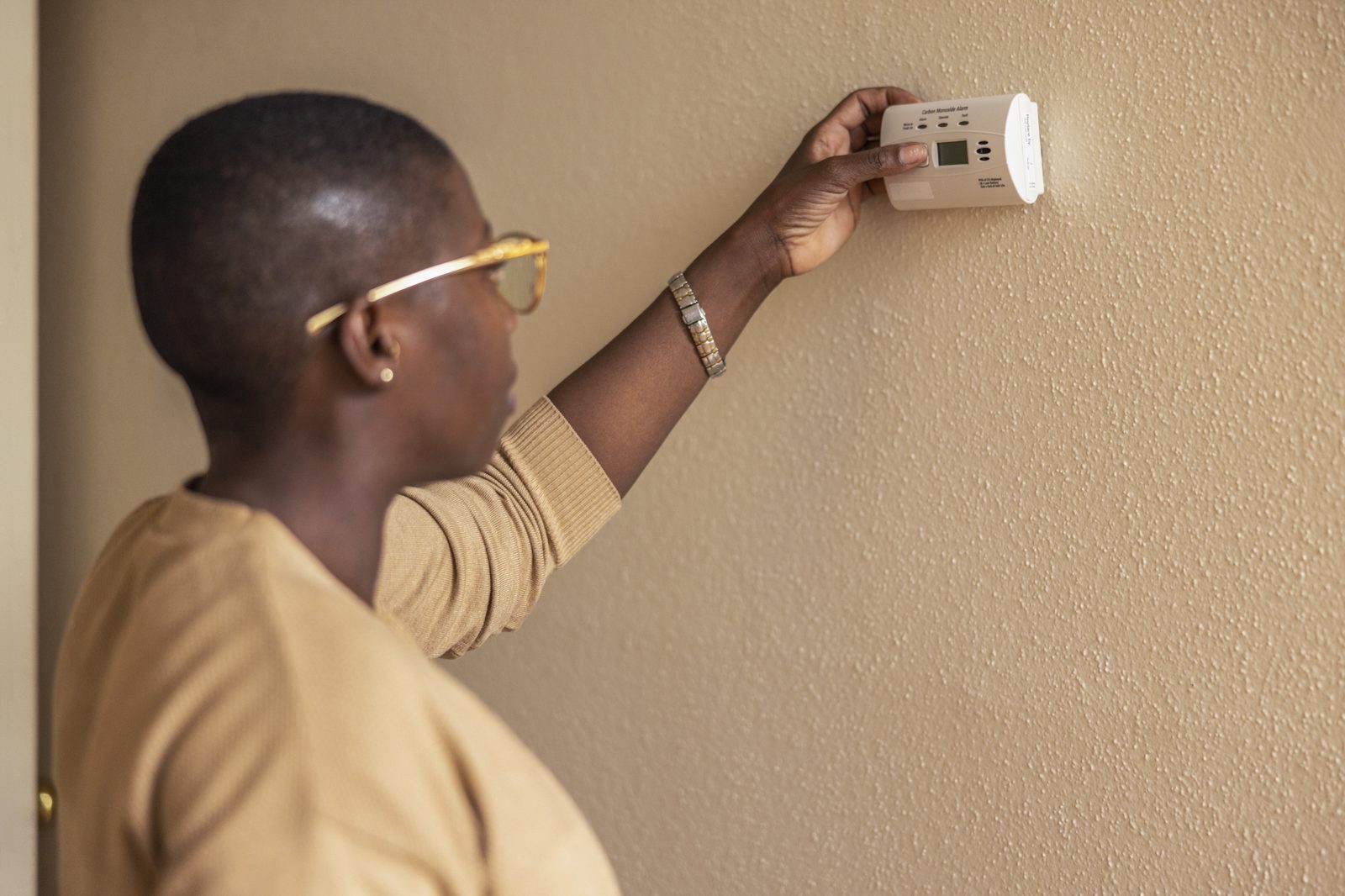
Buy a battery CO alarm, or a plug-in or hardwired one with battery backup, so it keeps working when the power is out. Put one in the hallway outside the bedrooms and one on every level of your home, test it monthly, and replace it by the date on the back: makers rate most alarms for 7 to 10 years. A smoke alarm won’t detect carbon monoxide unless it’s a combination smoke and CO alarm.
Battery, plug-in or hardwired
The CDC says to use battery-operated or battery backup CO alarms, and the CPSC says hardwired and plug-in alarms should have a battery backup. A plug-in alarm without one goes quiet in an outage, just when generators, heaters and camp stoves come out.
| Type | In a power cut | Good to know |
|---|---|---|
| Battery (usually AA) | Keeps working | Goes anywhere, renters included. Check the batteries when the clocks change. |
| Sealed 10-year battery | Keeps working | No battery changes. You replace the whole alarm after 10 years. |
| Plug-in with battery backup | Runs on its backup battery | Needs an outlet near the bedrooms that isn’t switched or on a dimmer (Kidde). |
| Hardwired with battery backup | Runs on its backup battery | NFPA suggests interconnected alarms if you can, so one sets off the rest. Check the backup battery is fitted. |
| Combination smoke and CO | Depends on the power type above | One unit does both jobs (CPSC). A plain smoke alarm doesn’t detect CO (Health Canada). |
Backup batteries vary by model: Kidde’s plug-in alarm takes 2 AA, while First Alert’s uses a 9-volt. Some models, such as First Alert’s CO710, have a digital display that shows the CO level: a nice extra, not a must.
Look for the mark
In Canada, Health Canada says to buy alarms with the CSA 6.19 mark on the alarm and the packaging; Ontario also accepts ULC and Intertek marks. In the US, UL 2034 is the standard the CPSC tests alarms against, and NFPA says to choose one labelled by a recognized testing laboratory.
How many, and where they go
NFPA says to put a CO alarm in a central spot outside each sleeping area and on every level of the home. Health Canada calls the hallway outside the bedrooms the most important place. Since January 1, 2026, Ontario requires one next to each sleeping area and on every storey in homes with a fuel-burning appliance, a fireplace or an attached garage.
| Home | Working | CO alarms |
|---|---|---|
| Apartment | 1 outside the bedrooms | 1 |
| Two-level house | 2 levels × 1 | 2 |
| Two-level house with an indoor propane heater (US) | 2 levels × 1 + 1 for the heater room | 3 |
| Three-storey house in Ontario with a fuel-burning appliance | 3 storeys × 1 | 3 |
If bedrooms are at opposite ends of one floor, add an alarm outside each group of bedrooms. The safety step of the kit builder counts one per level and shows battery models for your country.
Height and spots to avoid
CO alarms can go in a plug-in outlet or high on the wall (CPSC). Keep them where furniture and curtains won’t cover them, and away from heating vents (CPSC). Makers add a few more rules to avoid false alarms:
- At least 15 ft (4.6 m) from heating and cooking appliances. Kidde allows 5 ft (1.5 m) but recommends 15; First Alert says 20 ft (6 m) from a furnace or other fuel-burning heater.
- Not in the kitchen, garage or furnace room, and not near doors, windows, ceiling fans, vents or chimneys (Kidde).
- At least 10 ft (3 m) from a bath or shower (First Alert).
- Where the temperature stays between 40°F and 100°F, or 4°C and 38°C (Kidde).
Models differ, so read the placement page in your alarm’s manual before you mount it.
Test it, and know the sounds
Press the test button at least once a month (NFPA, CPSC); Kidde’s and First Alert’s manuals say weekly. The button checks that the alarm’s circuits work, not how accurate the sensor is (CPSC), so the replacement date still matters.
| What it means | Kidde (plug-in KN-COB-DP2) | First Alert |
|---|---|---|
| Carbon monoxide | 4 quick beeps, then 5 seconds of quiet | 4 beeps and a pause |
| Low battery | 1 chirp every 60 seconds | 1 beep every minute |
| Replace the alarm | 2 chirps every 30 seconds | 5 beeps every minute |
Other models use other patterns, so keep the manual, or check the label on the back of the alarm.
Batteries and replacement age
- Batteries: check them when the clocks change in spring and fall (CDC), and again during an outage (Public Safety Canada). Our battery guide counts a spare set for each alarm.
- The whole alarm: most have a replace-by date on the back. Kidde says most of its alarms made since 2013 last 10 years, and older ones 7. First Alert’s sealed 10-year models must be replaced after 10 years or when they reach end of life, whichever comes first.
- No date? The CDC says to replace it every 5 years.
Take the end-of-life chirp seriously: Kidde says an alarm in end-of-life mode no longer detects carbon monoxide.
If it sounds
Get out first, then call
Get everyone outside to fresh air straight away, then call 911 or the fire department from outside. Don’t stop to look for the source, and don’t go back in until responders say it’s safe. (CPSC, NFPA, Public Safety Canada)
Our guide to generators and carbon monoxide covers where carbon monoxide comes from in an outage and how to keep it outside.
Our picks
What the kit builder suggests right now, in the order we would pick them.
- Kidde Battery CO Alarm (AA) on Amazon (opens in a new tab) AA batteries · 85 dB · LED status $27.97
- First Alert CO400 Battery Alarm on Amazon (opens in a new tab) AA batteries · 85 dB $21.99
- First Alert CO400, 2-pack on Amazon (opens in a new tab) 2 alarms · AA batteries $34.99
- First Alert SMCO100 Smoke + CO on Amazon (opens in a new tab) Smoke + CO · AA batteries $36.99


- Kidde Nighthawk Battery CO Alarm on Amazon (opens in a new tab) AA batteries · Canadian model KN-COB-B-LP $42.00
- First Alert CO605A Plug-In on Amazon (opens in a new tab) Plug-in · 9V battery backup $33.99
- Kidde C3010D 10-Year Sealed on Amazon (opens in a new tab) Sealed 10-yr battery · digital display $59.29
- First Alert CO710A 10-Year on Amazon (opens in a new tab) Sealed 10-yr battery · display · temperature $60.99


Prices are the last we saw on Amazon and may have changed. Outage Kits earns a commission on qualifying Amazon purchases; it doesn't change what we suggest.
Sources (14)
- CDC, Carbon monoxide poisoning basics
- NFPA, Carbon monoxide
- CPSC, Carbon monoxide questions and answers
- CPSC, CO alarms
- CPSC, Carbon monoxide research and statistics
- Health Canada, Carbon monoxide: preventing exposure
- Ontario Solicitor General, Carbon monoxide alarm rules for homes
- Public Safety Canada, Power outages: how to prepare
- Kidde, When to replace a carbon monoxide alarm
- Kidde, Carbon monoxide safety basics
- Kidde, KN-COB-DP2 user guide
- First Alert, What does the beep mean?
- First Alert, CO605 plug-in alarm with battery backup
- First Alert, CO710 user manual
Turn the advice into a shopping list
Tell us who lives at home and how many days you want to cover. We work out the amounts, you pick what to buy and what you already have.
Build a kit for your household
About 5 minutes. We work out the amounts for you.