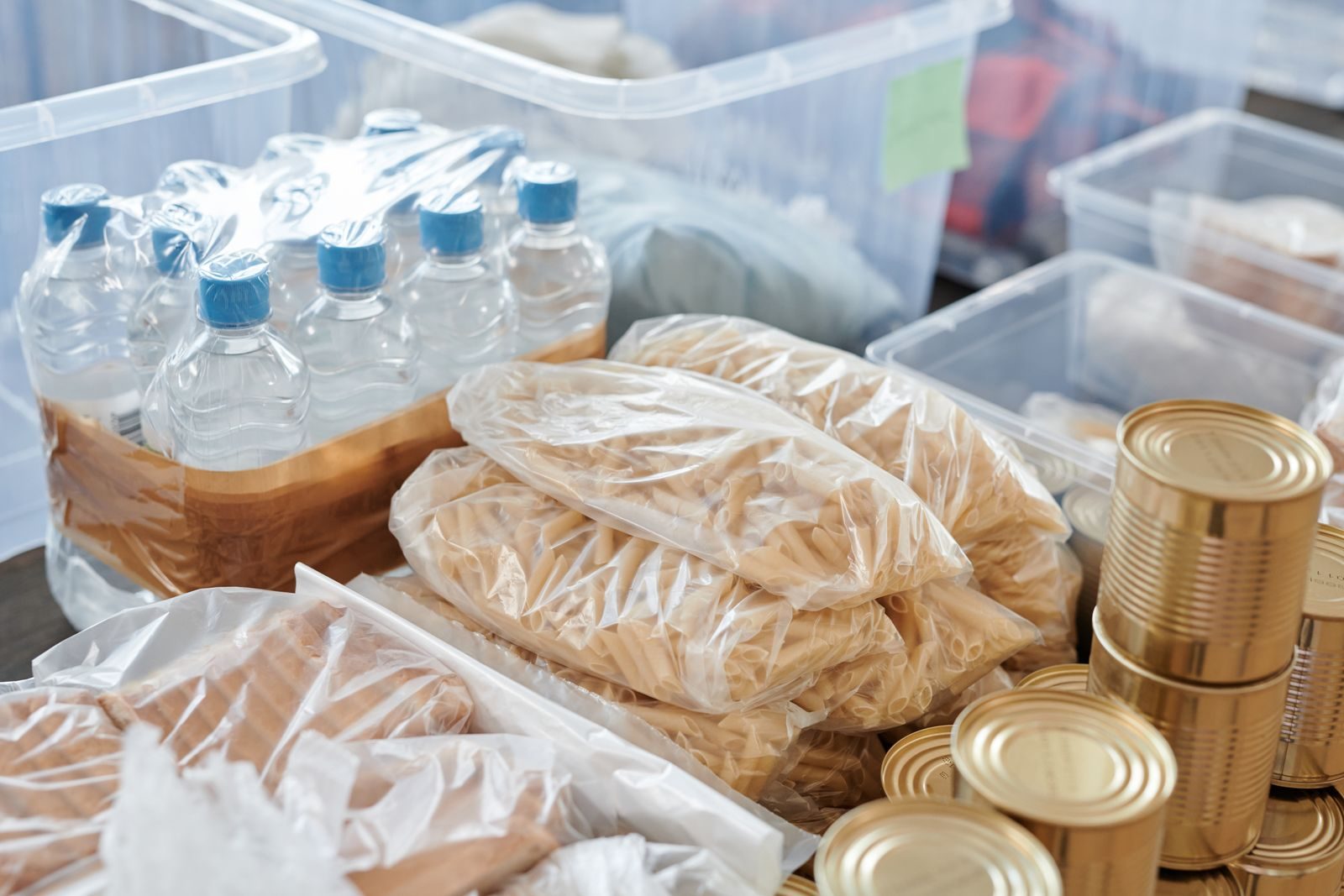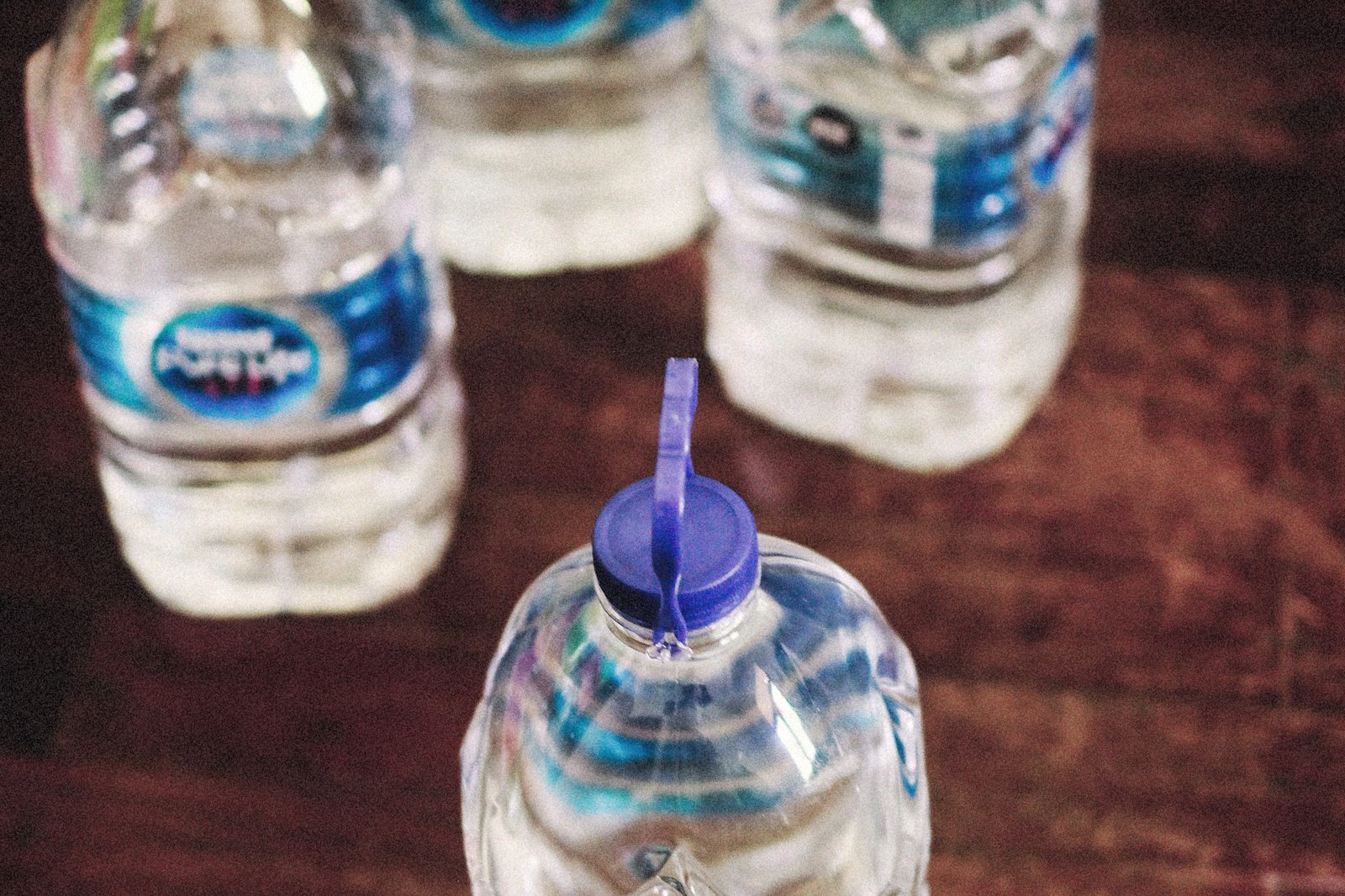
Buy food-grade jugs you can lift. Use 1-gallon (4 L) jugs where space or strength is short, and 5 to 7 gallon (19 to 26 L) jugs for the main supply. Sealed store-bought water counts too. A family of four needs 28 gallons for a week in the US, or 112 L in Canada, which fits in four or five big jugs. Add a bathtub bladder when a storm is on the way.
Pick the size you can carry
Water is heavy: a US gallon weighs 8.34 lb and a litre weighs 1 kg (USGS). That sets the size more than anything else. If you can’t lift a full jug to pour it, you’ll need a pump or smaller jugs.
| Container | Holds | Full, it weighs | Good for |
|---|---|---|---|
| Small bottles | 500 mL (16.9 oz) | 1.1 lb (0.5 kg) | Grab-and-go bags and kids |
| Store-bought jugs | 1 gal (3.8 L) or 4 L | 8.3 lb (3.8 kg) or 8.8 lb (4 kg) | Easy pouring; keep them sealed |
| Refillable 1-gal jugs | 1 gal (3.8 L) | 8.3 lb (3.8 kg) | Apartments and anyone who can’t lift much |
| 5-gal jugs | 5 gal (19 L) | 42 lb (19 kg) | Most families’ main supply |
| 7-gal jugs | 7 gal (26 L) | 58 lb (26 kg) | Fewer jugs; fill them where they’ll stay |
| Stackable 5-gal containers | 5 gal (19 L) each | 42 lb (19 kg) each | Closets and shelves |
| 55-gal barrel | 55 gal (208 L) | 459 lb (208 kg) | A garage or basement; it can’t be moved once full |
| Bathtub bladder | Up to 100 gal (378 L) | Stays in the tub | Filling when a storm is forecast |
Public Safety Canada suggests including small bottles that are easy to carry. A barrel needs extras: Augason Farms sells its 55-gallon barrel with a siphon pump, which moves water without tipping the barrel, and a bung wrench to open and seal the lid.
How many containers for your household
Plan on 1 gallon per person per day in the US (Ready.gov, CDC) or 4 L in Canada (Health Canada, Public Safety Canada). Multiply by people and days, then divide by what one container holds.
| Household, 7 days | Water needed | One way to hold it |
|---|---|---|
| Family of four, US | 4 × 7 × 1 gal = 28 gal (106 L) | 4 jugs of 7 gal, or 6 jugs of 5 gal |
| Family of four, Canada | 4 × 7 × 4 L = 112 L | 5 jugs of 26 L, or 6 jugs of 19 L |
| Couple in an apartment, US | 2 × 7 × 1 gal = 14 gal (53 L) | 14 jugs of 1 gal, or 3 jugs of 5 gal |
| Couple in an apartment, Canada | 2 × 7 × 4 L = 56 L | 14 jugs of 4 L, or 3 jugs of 19 L |
Pets add about ½ gallon (2 L) a day each. The water step of the kit builder does this sum for your household and suggests the containers, and our guide to how much water to store explains the daily amounts.
Food-grade, and what not to reuse
Ready.gov says to buy food-grade water storage containers if you’re filling your own. The CDC adds a tight cap, an unbreakable material and, if you can, a narrow opening for pouring.
- Skip glass. It’s heavy and may break (FEMA and Red Cross).
- Skip milk and juice jugs. Milk protein and fruit sugars can’t be washed out well enough (FEMA and Red Cross).
- Never reuse a chemical container, such as one that held bleach or pesticide (CDC).
- Old soda bottles are a stopgap. FEMA’s booklet allows 2-litre pop bottles, but Health Canada advises against refilling single-use bottles. Proper jugs avoid the question.
Before you fill new jugs, wash them with soap and water, then rinse them with 1 teaspoon of plain unscented bleach mixed into 1 quart (about 1 L) of water (CDC).
Store-bought water
Bottled water is the simplest start. Keep it sealed in its original container in a cool, dark place (Ready.gov), and go by the date on the label (CDC). Health Canada notes that makers give bottled water a two-year shelf life, but suggests replacing water kept for emergencies after one year.
Where to keep them
- Somewhere cool and out of sunlight: the CDC suggests 50 to 70°F (10 to 21°C).
- Away from gasoline, pesticides and cleaning products (CDC, Health Canada).
- Where they’ll stay. Fill big jugs in place, since a 7-gallon jug weighs 58 lb (26 kg) full.
- In an apartment, 1-gallon or 4 L jugs fit in a closet, under a bed or at the back of a cupboard. Our apartment guide has more ideas.
Date it and swap it
Write the fill date on every jug you fill yourself, and replace the water every six months (CDC). Store-bought water goes by its date in the US, or about a year in Canada (Health Canada). One afternoon twice a year does it: empty the old water onto the garden, rinse and refill.
Bathtub bladders and fold-flat jugs
Some containers are for filling at the last minute. A bathtub bladder sits in the tub and fills from the tap. waterBOB says its bladder holds up to 100 gallons (378 L), is made of food-grade plastic, keeps water fresh for up to 16 weeks and comes with a pump to fill jugs and pitchers. It’s designed for one use. Fold-flat jugs work the same way on a smaller scale: they pack away small until you need them.
When a storm is forecast
Fill clean containers with drinking water in case the supply is cut (CDC). You can also fill the sinks and bathtub for washing and flushing. Plain tub water isn’t for drinking (FEMA), so keep drinking water in jugs or a bladder.
Our picks
What the kit builder suggests right now, in the order we would pick them.
- FastRack 1 gal jugs, 10-pack on Amazon (opens in a new tab) 10 × 1 gal rigid HDPE jugs · 10 gal total $40.09
- CoreMuse collapsible jug 2.1 gal on Amazon (opens in a new tab) 2.1 gal · collapsible · spout $13.99
- FastRack Hedpak 5 gal on Amazon (opens in a new tab) 5 gal rigid HDPE carboy · screw cap $24.18
- Scepter military jug 5 gal on Amazon (opens in a new tab) 5 gal · heavy-duty · food grade $58.37


- Hedpak 5 gal carboy on Amazon (opens in a new tab) 19 L rigid HDPE · handle · food grade $34.99
- Cedilis collapsible jug, 2-pack on Amazon (opens in a new tab) 2 × 20 L collapsible · spigot $31.00
- YOSN water jug 13 L on Amazon (opens in a new tab) 13 L · spigot · BPA free $47.99
- REDCAMP water container 15 L on Amazon (opens in a new tab) 15 L · spigot $63.99


Prices are the last we saw on Amazon and may have changed. Outage Kits earns a commission on qualifying Amazon purchases; it doesn't change what we suggest.
Sources (12)
- Ready.gov, Water
- CDC, How to create an emergency water supply
- CDC, Hurricane safety
- FEMA and American Red Cross, Food and water in an emergency
- FEMA, Hurricane preparedness fact sheet
- USGS, A million gallons of water: how much is it?
- USGS, Facts about water
- Health Canada, Frequently asked questions about bottled water
- Health Canada, Food and drinking water safety in an emergency
- Public Safety Canada, Emergency kits
- waterBOB, Bathtub water storage
- Augason Farms, Water treatment and storage kit
Turn the advice into a shopping list
Tell us who lives at home and how many days you want to cover. We work out the amounts, you pick what to buy and what you already have.
Build a kit for your household
About 5 minutes. We work out the amounts for you.