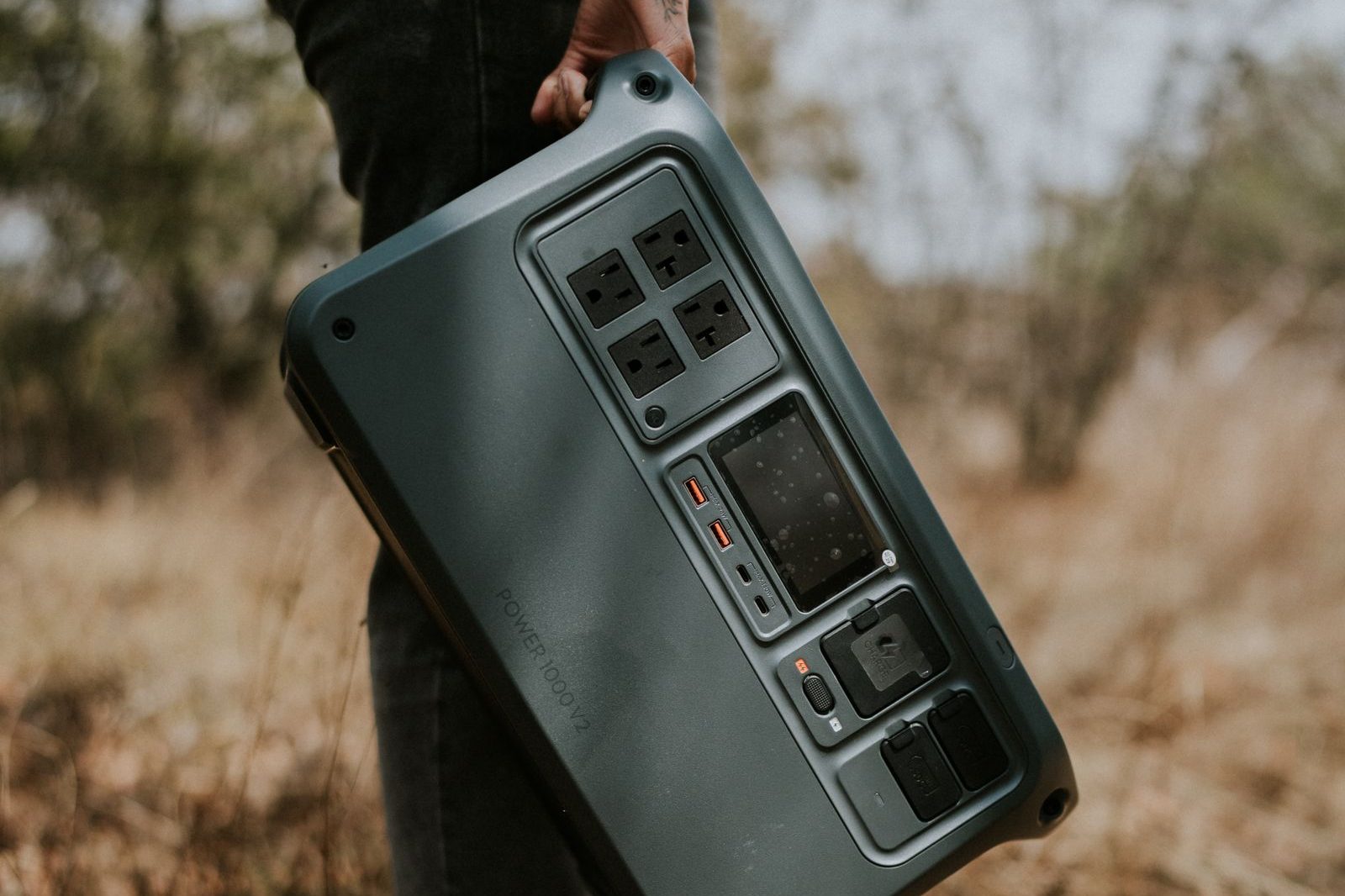
Size a power station by the watt-hours (Wh) you use in a day, not by the biggest number on the box. Add up your devices, divide by 0.85 for conversion losses, and plan to recharge once a day. Two phones, internet, two lamps and a humidified CPAP come to about 670 Wh a day, so a 1,000 Wh station; add a full-size fridge and you’re closer to 3,000 Wh.
Add up your watt-hours per day
A watt-hour is one watt for one hour, so watts × hours of use gives you watt-hours (Virginia Cooperative Extension). A 9 W LED bulb lit for 5 hours uses 45 Wh. These are our planning numbers; a plug-in electricity meter will show what your own fridge or CPAP draws.
| Device | Watts while running | Plan per day |
|---|---|---|
| Phone, one full charge | 5 to 20 W | 20 Wh |
| Router and modem, on all day | 10 to 20 W | 360 Wh |
| LED lamp, 800 lumens | 9 W | 45 Wh (5 h, winter) or 27 Wh (3 h, summer) |
| Laptop, one recharge | 50 to 60 W | 70 Wh |
| CPAP, no humidifier | About 7 W average | 60 Wh a night |
| CPAP with humidifier | About 22 W average | 180 Wh a night |
| CPAP, humidifier and heated tube | About 34 W average | 280 Wh a night |
| Electric blanket, double | 100 W | 400 Wh a night |
| Chest freezer | About 90 W | 750 Wh |
| Full-size fridge | About 150 W | 1,500 Wh |
The fridge is the big decision. Natural Resources Canada puts the average new fridge sold in Canada at 1.32 kWh a day for 2020 models and 1.75 kWh for 2000 models, so we plan on 1,500 Wh: more than phones, internet, lamps and a CPAP combined.
You don’t have to run it nonstop. Keep the door shut and plug it in when a fridge thermometer climbs toward 40°F (4°C). Our guide to keeping food safe when the power goes out has the timings.
Divide by 0.85, then round up
Some energy is lost turning battery power into wall power. Jackery’s runtime formula counts 85% of a station’s capacity as usable, so:
Station size = Wh per day × days between recharges ÷ 0.85
The inverter also draws power just by being on: one owner measured a BLUETTI AC200 at 17 W with the AC outlets on and nothing plugged in. Idle draw of 10 to 20 W adds up to 240 to 480 Wh a day, so switch the AC side off between uses.
Worked examples
| Household | Wh per day | ÷ 0.85 | Station |
|---|---|---|---|
| 2 adults: 2 phones, router, 2 lamps in winter, CPAP with humidifier | 2 × 20 + 360 + 2 × 45 + 180 = 670 | 790 Wh | 1,000 Wh |
| The same, plus the fridge | 670 + 1,500 = 2,170 | 2,550 Wh | 3,000 Wh, or 2,000 Wh if the fridge runs part of the day |
| CPAP with humidifier, two nights | 2 × 180 = 360 | 424 Wh | 500 Wh |
| Phones and lamps for 2 adults and 2 children | 2 × 20 + 2 × 45 = 130 | 153 Wh | Power banks will do |
The power step of the kit builder runs this sum for the devices you tick and suggests a size.
CPAP and other medical devices
ResMed measured its Air10 machines at about 7 Wh an hour alone, 22 with the humidifier and 34 with a heated tube as well: 60, 180 or 280 Wh over an 8-hour night. Turning the humidifier off triples your nights, and a DC cable that skips the inverter saves more. Size for at least two nights, which is why the CPAP row above lands on 500 Wh.
Continuous watts and surge watts
Watt-hours say how long a station lasts; watts say what it can run. The continuous AC rating must beat everything running at once, and the surge rating must cover the biggest motor as it starts.
A motor draws about three times its running current while starting (Virginia Cooperative Extension). EWEB, an Oregon utility, allows a fridge 700 running watts plus 2,200 starting watts, a cautious figure for older motors. Our rule of thumb: at least 1,000 W continuous for a full-size fridge.
Check the label on sump pumps, well pumps and furnace blowers, and expect 2,000 to 3,500 W at start, plus 240 V for many well pumps. Most are hardwired, Portland General Electric notes, so they need a transfer switch fitted by a professional.
LiFePO4 and battery life
LiFePO4, also sold as LFP, is the chemistry to look for: makers rate it in the thousands of charge cycles. EcoFlow rates its DELTA 2, an LFP model, at 3,000 cycles to 80% capacity, and Jackery lists its 1000 v2 generation at 4,000 or more cycles to 70%. If a listing gives no chemistry or cycle rating, compare it against those.
For storage, EcoFlow’s DELTA Pro manual says to cycle the battery every three months and keep it at about 60%. Other models differ, so follow your manual, and charge it full when a storm is forecast.
Days between recharges
Size for one day if you can top up daily from solar, the car, a generator or a warming centre. With no way to recharge, use two: the CPAP household above would need 670 × 2 ÷ 0.85 = 1,576 Wh, so a 2,000 Wh station.
Don’t multiply by the whole outage. A week of fridge power is about 12 kWh (1,500 × 7 ÷ 0.85), which is a home battery, not a portable station. Past 3,000 Wh a day, run the big loads in shifts, add a generator with a transfer switch, or both.
Solar refills it slowly in winter
NREL’s PVWatts model gives these daily averages for a 100 W panel facing south at a fixed 35° tilt:
| City | June, Wh per day | December, Wh per day |
|---|---|---|
| Toronto | 457 | 182 |
| Chicago | 449 | 220 |
| Boston | 398 | 227 |
| Seattle | 414 | 126 |
| Denver | 491 | 372 |
| Houston | 399 | 311 |
| Phoenix | 519 | 441 |
Plan on about 4 Wh per panel watt per day in late spring and summer, and about 2 in a northern winter. Panels lying flat or partly shaded make less. For the 670 Wh household, 790 Wh ÷ 4 = about 200 W of panel in summer, or 790 ÷ 2 = about 400 W in a northern winter. Treat solar as a top-up for phones, internet and lights, not the fridge.
What a power station can’t run
Heat is the big one. A space heater draws 750 to 1,500 W, and a 1,500 W heater empties a 1,000 Wh station in about 34 minutes (1,000 × 0.85 ÷ 1,500 = 0.57 hours). Kettles, microwaves, coffee makers and hair dryers stay off the list for the same reason.
Oxygen concentrators need a different plan
A home oxygen concentrator such as the Philips EverFlo averages 350 W, or 8,400 Wh a day. That’s about 9,900 Wh of station (8,400 ÷ 0.85), far beyond a portable one. Ask your oxygen supplier for backup cylinders and an outage plan, and tell your utility someone at home relies on powered equipment.
Generators are a different tool
A generator runs as long as it has fuel, so it can keep a fridge, a freezer and pumps going for days on a few gallons. A 2,000 to 2,500 W inverter model such as the Honda EU2200i runs about 8.5 hours per gallon at light load, or 3.4 at full load. Twelve hours a day at light load is 1.4 gal (5.3 L) a day, about 10 gal (38 L) a week.
The trade-off is exhaust. The CPSC says nearly 100 people a year die in the US from carbon monoxide from portable generators, while battery stations make none (Public Safety Canada).
Outdoors only, and never into a wall outlet
Run a generator outdoors, at least 20 ft (6 m) from windows, doors and vents, and never in a garage, basement, shed, porch or carport (CDC, CPSC, Health Canada). Keep a battery CO alarm working in the house. Never plug a generator into a wall outlet: it can energize the lines outside and injure utility crews and neighbours. A furnace, well pump or sump pump connects only through a transfer switch installed by an electrician (Public Safety Canada, FEMA).
Store gasoline in approved cans outside the house, away from anything with a pilot light, and let the generator cool before you refuel (FEMA). Use a heavy-duty outdoor cord at least 25 ft (7.5 m) long so the generator can stay 20 ft from the house. Our guide to generators and carbon monoxide has the full routine.
Our picks
What the kit builder suggests right now, in the order we would pick them.
- EcoFlow DELTA 3, 1,024 Wh on Amazon (opens in a new tab) 1,024 Wh LFP · 1,800 W AC $579.00
- EcoFlow RIVER 2, 256 Wh on Amazon (opens in a new tab) 256 Wh LFP · 300 W AC $209.00
- BLUETTI Elite 30 V2, 288 Wh on Amazon (opens in a new tab) 288 Wh LFP · 600 W AC $289.99
- EcoFlow RIVER 2 Max 500, 499 Wh on Amazon (opens in a new tab) 499 Wh LFP · 500 W AC $309.00


- EcoFlow DELTA 2, 1,024 Wh on Amazon (opens in a new tab) 1,024 Wh LFP · 1,800 W AC $599.00
- Jackery Explorer 300, 292 Wh on Amazon (opens in a new tab) 292 Wh · 300 W AC $258.99
- BLUETTI Elite 30 V2, 288 Wh on Amazon (opens in a new tab) 288 Wh LFP · 600 W AC $269.00
- Jackery Explorer 500 v2, 512 Wh on Amazon (opens in a new tab) 512 Wh LFP · 500 W AC $439.00


Prices are the last we saw on Amazon and may have changed. Outage Kits earns a commission on qualifying Amazon purchases; it doesn't change what we suggest.
Sources (22)
- Virginia Cooperative Extension, Estimating Appliance and Home Electronic Energy Use
- Natural Resources Canada, Energy consumption of refrigerators
- Natural Resources Canada, Energy consumption of freezers
- EnergySage, How many watts does a Wi-Fi router use?
- FTC, Shopping for light bulbs
- ResMed, Power consumption of Air10 devices
- Philips, EverFlo home oxygen system
- EWEB, Generator sizing considerations
- Portland General Electric, Powering wells during a power outage
- Jackery, What can Jackery 600 Plus run
- BLUETTI community, AC200 standby power consumption
- StorageReview, EcoFlow DELTA 2 review
- Jackery, What is the lifespan of different Jackery products
- EcoFlow DELTA Pro user manual
- NREL, PVWatts calculator
- Honda EU2200i specifications
- CPSC, As winter storms impact millions, CPSC issues safety tips
- CDC, What to do to protect yourself during a power outage
- Public Safety Canada, Power outages: how to prepare
- Health Canada, Carbon monoxide: preventing exposure
- FEMA, Be safe when using a portable generator
- Ready.gov, Power outages
Turn the advice into a shopping list
Tell us who lives at home and how many days you want to cover. We work out the amounts, you pick what to buy and what you already have.
Build a kit for your household
About 5 minutes. We work out the amounts for you.